
Organizations engage in evaluations to gain a better understanding of their operations, programs, and policies. But did you know that an organization doesn't have to be in the implementation phase of an evaluation to gain these benefits? It’s common practice for organizations to learn more about their operations, including their own evaluation capacities, when learning about the basics of, and making preliminary plans for, evaluation. This is exactly what happened with AMP - and not just once!
AMP’s Evaluation Recap
Before diving deeper into AMP’s evaluation and evaluation capacity-building journey, let's take a quick look back at their experiences introduced thus far.
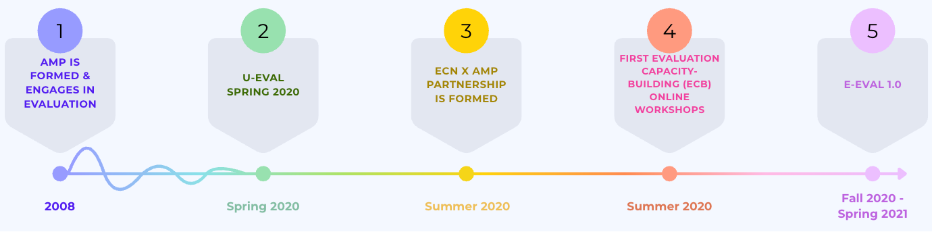
(1) Since first being formed, AMP has been conducting evaluations every three years to assess whether their actions have helped them in upholding the mentoring profile across Alberta.
(2) COVID-19 posed a challenge to face-to-face mentoring programs across Alberta. In a time of uncertainty, AMP and many partnering mentor agencies identified the need for specialized evaluation support to assess the effectiveness of their new virtual mentoring programs. This support came from the Evaluation Capacity Network at the University of Alberta through a graduate level course called U-Eval. AMP worked collaboratively with a group of graduate students to co-create an evaluation plan for online mentoring programs.
(3) Formation of the ECN x AMP Partnership in the Summer of 2020! After U-Eval in the spring of 2020, AMP recognized the benefits of learning more about evaluation, and wanted to bring this expertise and learning opportunity to other mentoring organizations across Alberta.
(4) The ECN developed and ran several online evaluation capacity-building (ECB) workshops in the summer of 2020. The primary goal was to introduce the basics of evaluation to AMP partners.
(5) E-Eval 1.0. In the fall of 2020, staff from six mentoring agencies across Alberta participated in the 6-month online evaluation capacity-building training called E-Eval. Developed and taught by the ECN, the mentoring staff learned the basics of evaluation while developing their own evaluation plans.
AMP staff learned a lot through their participation in an evaluation capacity-building training called E-Eval. The evaluation knowledge and skills varied from beginner to moderate capacities, across the participating staff from AMP and mentoring agencies. While E-Eval was informative and beneficial, the time commitment did not make it accessible to AMP and its partners. This underscored the need for further evaluation support in the partnership, to ultimately foster meaningful and impactful evaluations in Alberta’s mentoring profile and the larger social serving sector. Through AMP’s partnership with the Evaluation Capacity Network (ECN), this resulted in the development of another capacity-building training called Pre-Eval.
Pre-Eval - A Pre-evaluation Training
In the Spring of 2022, the ECN ran an eight-part introductory webinar series on evaluation called Pre-Eval. From defining evaluation to discussing specialized approaches of evaluation used in the mentoring and social serving sectors, Pre-Eval was designed to be an accessible learning tool, supporting both evaluation beginners and specialists. These 1-hour webinars were recorded and shared with AMP’s partnership and beyond to other organizations in the social serving network. Those who completed the series, either virtually or through the shared videos, were eligible to receive a certificate of completion. The recordings of the eight sessions are available to the public online. Take a look below for what each webinar covered!
|
Pre-Eval # 1 |
What is Program Evaluation & Why Do It? (Evaluation in social serving sectors, Community-Based Evaluation) |
|
Pre-Eval # 2 |
When to Start Planning an Evaluation (Types of Evaluation; Components of an Evaluation) |
|
Pre-Eval # 3 |
Building a Culture of Evaluation |
|
Pre-Eval # 4 |
Getting Started: Laying the Foundation for Evaluation (Stakeholder Engagement, Logic Model, Theory of Change) |
|
Pre-Eval # 5 |
Fitting Evaluation to Your Resources, Capacity, & Scope (Evaluation Purpose Statement, Questions) |
|
Pre-Eval # 6 |
Meaningful Methods: How to Collect Data that’s Useful for You |
|
Pre-Eval # 7 |
Ethical Considerations: Ethics in Evaluation & Working with Youth & Vulnerable Families |
|
Pre-Eval # 8 |
Analyze & Mobilize: Using What You’ve Learned from Your Evaluation |
Meet The Author

Rachel Zukiwsky, MEd
Doctoral Graduate Student
School and Clinical Child Psychology
University of Alberta
Hi everyone! My name is Rachel Zukiwsky, and I am a doctoral student in the School and Clinical Child Psychology program at the University of Alberta. My academic and professional studies focus on understanding and supporting the healthy development of children, youth, and their families. I have been working as a graduate research assistant with the Evaluation Capacity Network (ECN) at the University of Alberta since 2022, and in partnership with AMP to build evaluation awareness and capacities within AMP and their partnering organizations. As a passionate evaluator and future child psychologist, I feel so lucky to be working with AMP to support mentoring services across Alberta.